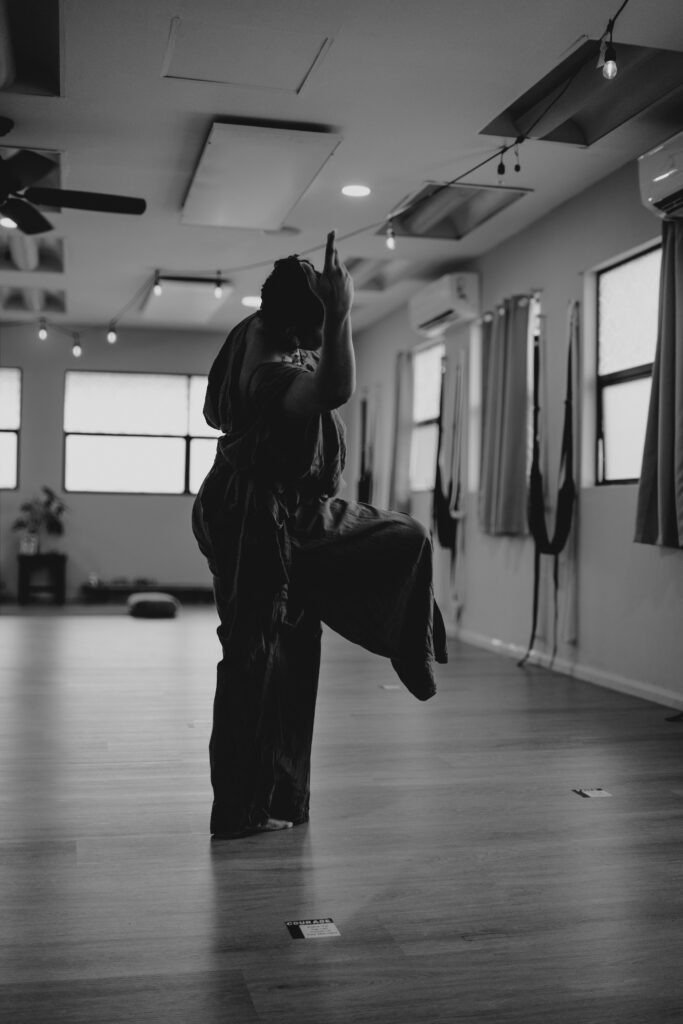
DISOBEDIENT BODIES
An ongoing investigation into how diasporic bodies inhabit, negotiate, and reworld Odissi through lived experience.
WHAT IS DISOBEDIENT BODIES?
Disobedient Bodies is an ongoing practice-based research project that examines how reconstructed Indian ‘classical’ dance forms—specifically Odissi—come into being through their encounter with lived bodies, histories, and place.
Rather than approaching Odissi as a static inheritance to be preserved, or as a form to be transcended or replaced, the project understands Odissi as a living technique that is continually produced through relation. Every act of practice and performance is contingent, situated, and irreproducible, even when it adheres to codified form.
Working from a Caribbean diasporic body shaped by multiple ancestral inheritances, Disobedient Bodies attends to how technique is negotiated in practice, where the body hesitates, adapts, exceeds, or reconfigures what the form prescribes.
Across studio practice, facilitation, and performance, the body is approached as a relational archive, carrying memory, pleasure, contradiction, and political history that actively shape how Odissi is learned, inhabited, and transmitted.
WHY ODISSI? WHY DISOBEDIENCE?
Odissi, as it is practiced today, emerged through twentieth-century processes of reconstruction shaped by colonial modernity, nationalist projects, and reformist morality. While these processes stabilised the form through codification, they also narrowed its permissible aesthetics, affective registers, and embodied possibilities.
Within this framework, deviation—whether through diasporic embodiment, altered sensuality, or intercultural inheritance—has often been framed as error, dilution, or loss. Disobedient Bodies does not seek to correct this history, nor to romanticise pre-revival lineages. Instead, it attends to how disobedience already operates within the form itself.
Disobedience here names the inevitable friction between codification and lived practice: the site where bodies shaped by different histories encounter technique differently. In this sense, contemporaneity is not something added to Odissi; it emerges through the form’s ongoing relation with lived experience.
The project insists that the question is not whether Odissi can be contemporary, but whose bodies are permitted to shape how that contemporaneity appears.