MAS RITUALS: A PERSONAL REFLECTION
My relationship with Carnival is grounded in an understanding of Mas as both sacred practice and a choreography of resistance.
Carnival is the political arena where my body wrestles with questions of ancestrality, identity, collective agency and power.
Photography by Lime Life Media.
My current exploration of Carnival focuses on presence, performance, and embodiment in Mas, particularly within Bat, Dragon, Jab, Moko Jumbie, and Blue Devil traditions. These forms demand more than performance as they call for full-bodied immersion into presence, chaos, unpredictability, and spiritual transformation.
I am particularly drawn to how dark archetypes operate at the edge of presence and possession, play and invocation, improvisation and trance. Within these states, I am beginning to explore how affect and emotion circulate beyond fixed categories — opening questions around rasa and how complex, layered emotional states are lived, embodied, and shared through Carnival performance, especially in moments of social and collective crisis.
Through reenactment and pre-enactment of ancestral and political memory, my work in Carnival performance attempts to reworld Mas archetypes into new expressions and gestures of consciousness that challenge and reshape the present. My research is both auto-ethnographic and embodied, grounded in lived experience and relational practice. I thoroughly enjoy and advocate for sharing the labor with communities to understand how Mas carries spiritual, cultural, and political force in contemporary struggle, where it is not only performed, but lived, embodied, and constantly reimagined.
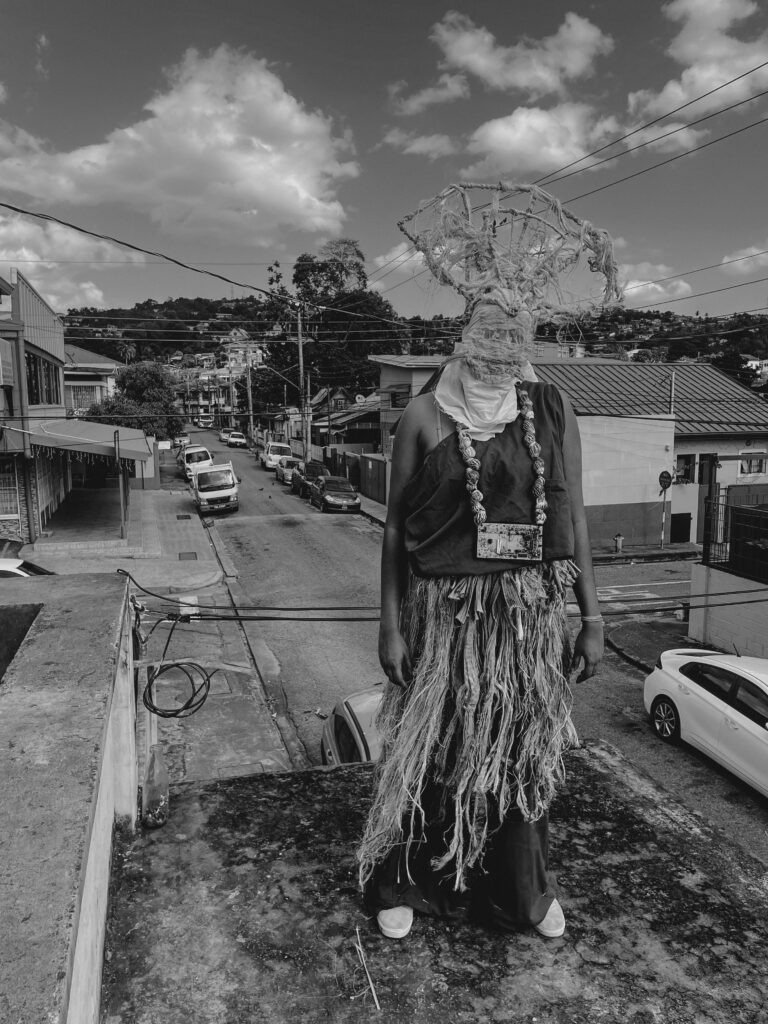
This mas portrays Mātaṅgī Devi, a dark-skinned Hindu goddess associated with marginality, pollution, and unregulated speech, to examine anti-blackness within the Indian diaspora. Aligned with the band’s overarching theme of anti–anti-Blackness, the work interrogates how caste logics, colourism, and proximity to whiteness continue to shape Indo-Caribbean identity, often quietly and without formal acknowledgment. By foregrounding Mātaṅgī's textual descriptions and her position outside structures of ritual purity, the portrayal resists the sanitisation of her image in modern depictions. It reframes Blackness as sacred presence and lived reality, positioning solidarity as an accountable practice that requires confronting hierarchy within diasporic communities themselves.
Embedded fieldwork with Moko Jumbie practitioner Adrian Young of Future Jumbies followed the full arc of his Kings and Queens of Carnival production—from early design thinking through costume build, rehearsals, logistics and performance. The work centred the making process and the relationships that sustain Moko practice. Production support and hands-on involvement in costume construction offered an inside view of how skill, trust, and collective labour shape the form. This experience grounds Disobedient Bodies and informs an upcoming work currently in development.
A portrayal of Mother Durga, the Hindu warrior goddess of protection and justice, riding a donkey alongside the people of Palestine on their journey home. This portrayal embodies both spiritual invocation and political resistance, symbolizing liberation, resilience, and the fight against displacement. Holding a bouquet of red poppies and the Palestinian flag, Durga embodies solidarity and the vision of a free and sovereign homeland.